LED vs Halogen Headlight Bulbs: Which Is Better?
For most cars with reflector headlights, quality halogen bulbs are often the safer choice. LED only tends to win when the housing is designed for it, or when a road-legal retrofit keeps beam cutoff and aim intact. Bad LED swaps can throw glare, shorten usable sight lines, and waste money on bulbs that fit poorly. This guide compares beam control, housing match, glare risk, and the tradeoffs that matter before you buy.
| Factor | LED | halogen headlight bulbs | Winner |
|---|---|---|---|
| Beam pattern | Can be excellent in the right housing; depends heavily on diode position and optics | Predictable in the housings they were designed around | halogen headlight bulbs |
| Glare risk | Higher in many reflector retrofits if cutoff and aim are not controlled | Usually lower in stock halogen housings | halogen headlight bulbs |
| Housing compatibility | Needs bulb base match, depth clearance, and thermal space | Fits the original design more often | halogen headlight bulbs |
| Heat management | Needs heat sink and often a driver; heat control affects life | Simpler thermal setup, but the filament runs hot by design | halogen headlight bulbs |
| Installation difficulty | Often more complex because of size, wiring, and drivers | Usually simpler as a direct replacement | halogen headlight bulbs |
| Lifespan | Usually longer, with lumen depreciation over time | Shorter and more prone to sudden burnout | LED |
| Upfront cost | Usually higher | Usually lower | halogen headlight bulbs |
| Best-use case | Projector housings, approved LED optics, and drivers who want longer service life | Reflector housings, budget replacements, and vehicles built around halogen | Tie, depending on housing |
LED vs halogen: the real trade-off
The real trade-off is straightforward. LED can bring better efficiency and longer life, while halogen headlight bulbs usually give more predictable beam control in the housings they were built for. That matters more than a big lumen claim because road visibility depends on where the light lands, not just how much light the box promises.
LED lighting products produce light up to 90% more efficiently than incandescent light bulbs, and LEDs are directional light sources. That directionality helps in the right optics, but it can work against you when the housing was designed around a filament instead of a diode. (Energystar)
What changes when the housing is the same
Swap only the bulb and the result can still change a lot. Reflector and projector optics shape the beam, set the cutoff, and control glare, so the same bulb can look fine in one housing and scatter light in another.
That is why raw lumens are only part of the story. Brightness without beam control can still send light into oncoming drivers instead of onto the road.
📊 LED lighting products produce light up to 90% more efficiently than incandescent light bulbs. Source: Learn About LED Lighting.
Headlight bulb comparison table
This table scores the two options across the buyer factors that decide real-world results. It is a direct housing check, budget check, and driving-pattern check, not a blanket win for either bulb type.
| Buyer factor | LED | halogen headlight bulbs | Winner |
|---|---|---|---|
| Beam pattern | Strong only when diode placement matches the optics | More consistent in stock reflector and projector designs | halogen headlight bulbs |
| Glare risk | Higher if the retrofit does not preserve cutoff and aim | Lower in a factory halogen setup | halogen headlight bulbs |
| Housing compatibility | Must match bulb base, housing depth, and electrical needs | Usually matches the original housing with less fuss | halogen headlight bulbs |
| Heat management | Needs heat sink and often a driver | Less hardware behind the bulb | halogen headlight bulbs |
| Installation difficulty | Can be cramped and fiddly | Usually simpler | halogen headlight bulbs |
| Lifespan | Longer potential service life, but cheap bulbs fail from heat or electronics issues | Shorter life overall | LED |
| Upfront cost | Higher | Lower | halogen headlight bulbs |
| Best-use case | Well-designed projectors, approved LED headlamps, frequent night driving with proper optics | Reflectors, older vehicles, and low-cost replacements | Tie |
Beam pattern
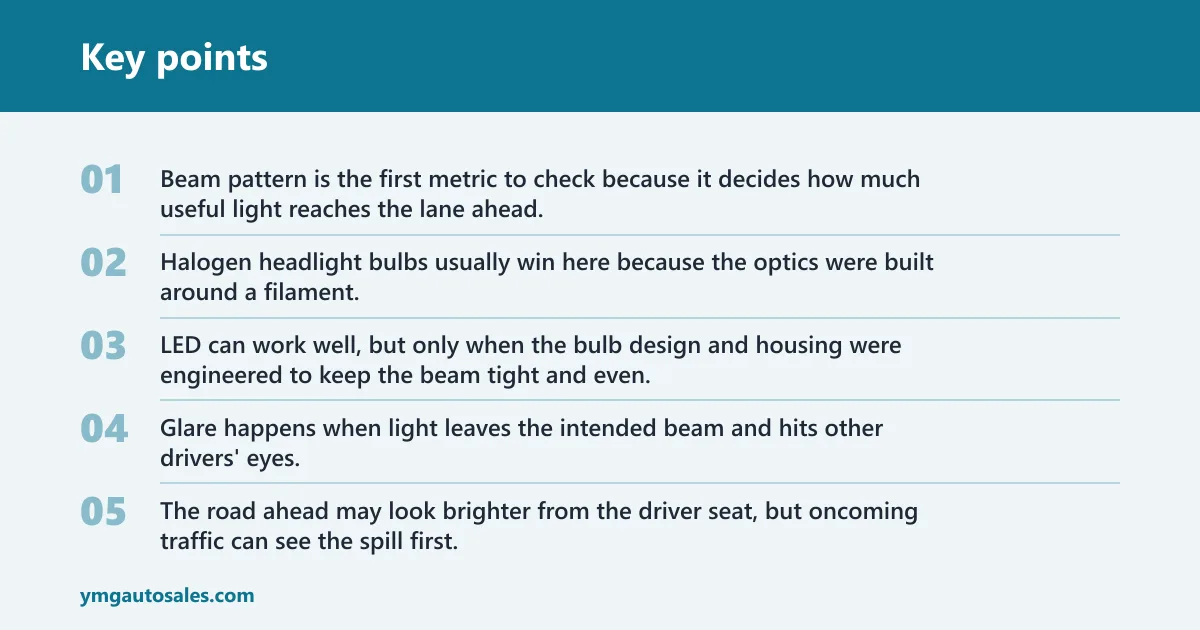
Beam pattern is the first metric to check because it decides how much useful light reaches the lane ahead. A bulb with impressive claimed output can still throw stray light above the cutoff if its light source does not match the housing geometry.
Halogen headlight bulbs usually win here because the optics were built around a filament. LED can work well, but only when the bulb design and housing were engineered to keep the beam tight and even.
Glare risk
Glare happens when light leaves the intended beam and hits other drivers’ eyes. That is more common with LED retrofits in reflector housings because the reflector is trying to shape a different light source than the one it was designed for.
Suppose a reflector housing takes an LED bulb with a tall heat sink and the beam cutoff rises a little after installation. The road ahead may look brighter from the driver seat, but oncoming traffic can see the spill first.
Housing compatibility
Fitment is more than a bulb base match. The bulb must also fit the rear of the housing, leave room for the heat sink, and clear any driver or wiring module that sits behind the dust cap.
Halogen headlight bulbs are usually the safer compatibility choice because the stock housing, connector, and space behind the lamp were built around them. LED replacements can work, but only when the physical and electrical package matches the vehicle.
Do LED headlight bulbs fit halogen housings?
LED headlight bulbs can sometimes fit halogen housings, but fit does not guarantee good road lighting. A bulb can slide into the socket and still perform badly if the reflector or projector optics cannot control its light source, or if the rear hardware crowds the housing.
Reflector housings
Reflector housings are often the hardest place for a casual LED swap. The reflector shape was made for a halogen filament, so a different light-emitting surface can change the beam, open up glare, or push light outside the cutoff.
Projector housings
Projector housings are usually more forgiving because the lens and shield can better contain the beam. That said, the result still depends on bulb geometry, so a projector does not automatically make every LED retrofit good.
Bulb base, depth, and driver space
The bulb base must match the socket exactly, and the rear of the bulb needs enough room for the heat sink and driver electronics. Many LED retrofits use an integrated driver or control module, so extra separate conversion hardware is not always needed, but any electronics package still has to fit and stay cool.
Will LED headlights be brighter than halogen?
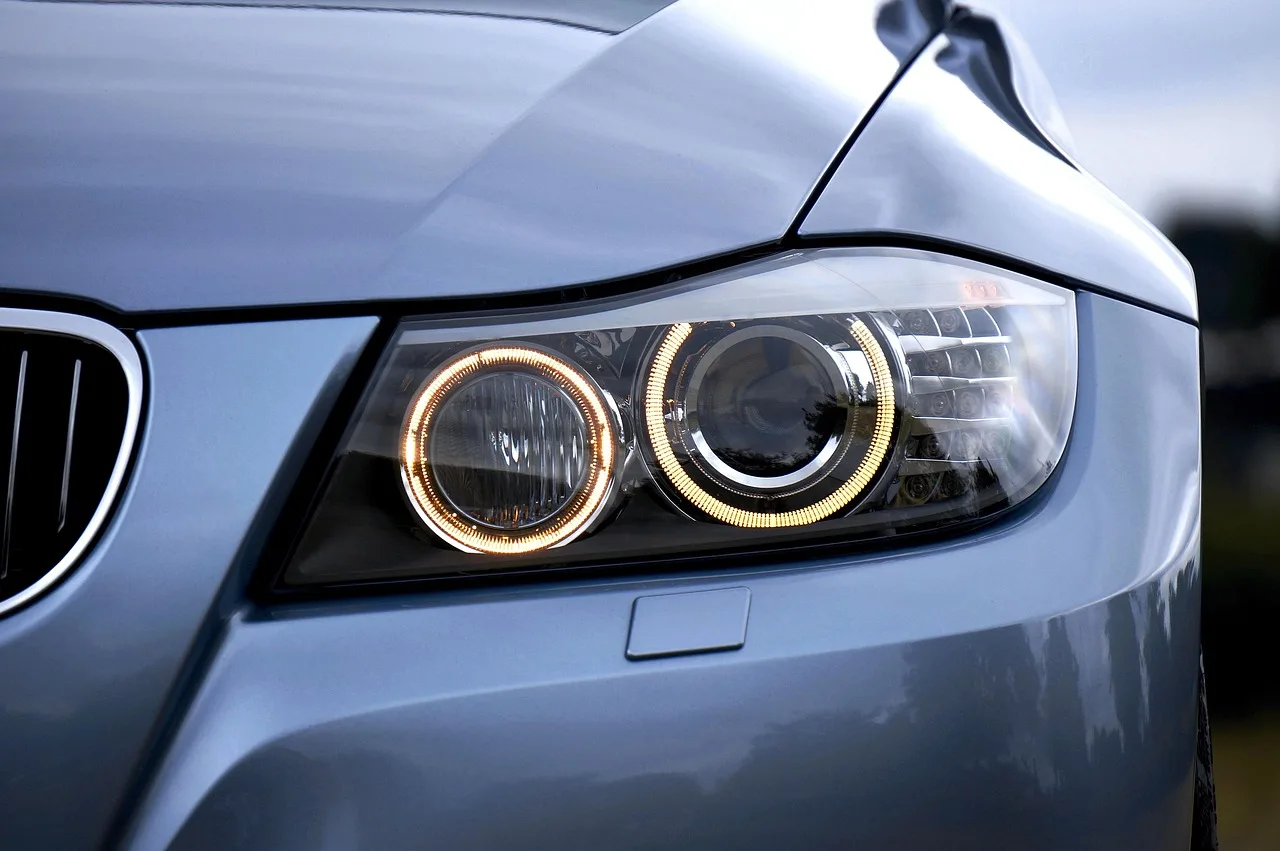
LED headlight bulbs can be brighter on paper and often look whiter to the eye, but that does not guarantee better road lighting. Brightness only helps if the housing places the light where you need it and keeps glare out of other lanes.
Lumens versus usable road light
Lumens measure brightness, but they do not tell you how well the beam is controlled. A well-focused halogen beam can be easier to use than a more powerful LED beam that spreads light high and wide.
That is why lumen claims deserve caution. Marketing can lean on a big number while the road result still depends on cutoff, aim, and the shape of the housing.
Why a brighter bulb can light the road worse
If the light source sits in the wrong spot, the reflector or projector sends some of that output where you do not want it. The driver may see more foreground brightness, but distance vision can get worse because the beam no longer reaches far enough down the lane.
A common first-timer mistake is choosing the brightest listing and ignoring the housing. The result can be more glare and less usable distance lighting than the stock bulb delivered.
Color temperature and perceived whiteness
Color temperature is measured in Kelvin. GoMechanic says a higher Kelvin rating looks cooler and bluish-white, while a lower Kelvin looks warmer and yellower.
Whiter light can look modern, but that does not mean it helps more in rain, fog, or on poorly marked roads. For general road use, a moderate white tone is usually easier on the eyes than a very blue one.
How glare and beam pattern change the result
Glare and beam pattern decide whether the bulb helps you or everyone else on the road. The key question is not whether the bulb is bright, but whether it sends that brightness into a controlled road pattern with a clean cutoff.
What a clean cutoff does
A clean cutoff holds the upper edge of the beam in place, so light goes onto the pavement instead of into mirrors and windshields. That matters in both city traffic and on two-lane roads where oncoming drivers are close.
Why reflector optics are harder for retrofits
Reflector optics spread light with a mirrored bowl, so they are sensitive to bulb position and light source shape. A small change in emitter height or rotation can turn a decent beam into one with hot spots and scatter.
This is why a brighter LED can still perform worse than halogen in the same reflector housing. The extra output does not help if the optics cannot contain it.
When projector housings handle LEDs better
Projectors often handle LED retrofits better because the lens and shield define the beam more tightly. Even then, the bulb still needs to match the housing depth and emitter placement, or the cutoff can soften and glare can rise.
Do LED headlight bulbs need a conversion kit?
Sometimes, especially when you are replacing halogen with LED and need extra wiring support, clearance, or a separate control module. Some retrofit bulbs are plug-in replacements with integrated drivers, so the need for added hardware depends on the specific bulb and vehicle.
LED driver basics
Many LED products need a driver to regulate current and control power to the LEDs. That electronics package may also provide protection and dimming support, but it has to match the load the bulb expects or the light can flicker or fail early.
Heat sink and thermal management
LED products use heat sinks to absorb and dissipate heat, and ENERGY STAR says thermal management is important for performance. GoMechanic also notes that LEDs need extra heat sinks and fans, which can help life when they fit well and fail when they do not.
LEDs experience lumen depreciation instead of burning out suddenly, so heat control matters for usable life and output over time. Poor thermal design can shorten that life quickly, especially in tight housings with limited airflow.
Fan noise, space limits, and failure points
A fan can create room for a smaller heat sink, but it also adds a moving part. Dust, heat soak, and cramped rear covers can turn that extra hardware into a problem, which is why cheap LED retrofit bulbs often fail at the driver or cooling stage before the diodes themselves age out.
Check the housing first. Identify whether you have reflector or projector headlights, then confirm the bulb base and rear clearance. If the housing cannot contain the beam or the back of the bulb, no upgrade will fix that.
Measure available space. Look behind the dust cap for room around the heat sink, fan, and driver. If the LED hardware presses against the cover, the installation may overheat or fail to seal.
Verify road legality. Check your state’s vehicle code or your country’s headlamp rules and product approval markings before buying. A bulb can fit the socket and still be a poor legal choice if the beam pattern or certification does not meet the rules where you drive.
Choose LED or halogen headlight bulbs
Choose LED if your housing is designed for it, or if you are using a proven retrofit that keeps cutoff, aim, and thermal control intact. Choose halogen headlight bulbs if you want the safest fit in a reflector housing, lower upfront cost, and the most predictable beam from a stock halogen setup.
Reflector headlights
Choose halogen headlight bulbs for reflector headlights unless you have a retrofit specifically proven for that housing. The reflector is the part most likely to turn an LED swap into glare.
Projector headlights
Choose LED when the projector and bulb geometry are a known match. A projector can support a cleaner beam than a reflector, but the bulb still has to fit the optics and the rear space.
City driving
Choose halogen headlight bulbs for mostly city driving if your stock lamps are already aimed well. City traffic puts glare risk front and center, and the simplest beam is often the least annoying to everyone else.
Frequent night driving
Choose LED if you spend a lot of time on dark roads and the housing supports it properly. The longer service life and whiter light can help, but only when beam control stays tight.
Verdict: LED or halogen headlight bulbs?
Choose LED if you have projector housings, approved LED optics, or a road-legal retrofit that keeps the beam cutoff and aim intact for longer service life and frequent night driving.
Choose halogen headlight bulbs if you have reflector housings, an older vehicle, or want a budget replacement with more predictable beam control and simpler fitment.
Frequently asked questions
Are LED headlight bulbs better than halogen bulbs?
Not always. LED can be the better choice for efficiency and lifespan, but halogen headlight bulbs often produce a more reliable beam in stock reflector housings. The better bulb is the one that matches the housing, protects cutoff, and keeps glare down.
Do LED headlight bulbs fit in halogen housings?
Sometimes they do, but fitment is only part of the answer. The bulb base, rear depth, heat sink, and driver all need space, and the housing has to shape the beam correctly or the retrofit can throw glare and lose distance lighting.
Are LED bulbs legal and safe for headlights?
They can be legal and safe, but only if the product and housing meet local rules. Safety depends on beam cutoff, aim, and glare control, so a good-looking bulb still is not enough if the light pattern is wrong.
Which lasts longer, LED or halogen headlight bulbs?
LED usually lasts longer. Heat control and driver quality still matter, though, because cheap LEDs can fail early.
Do LED headlights use less power than halogen?
Usually yes. LED lighting products produce light up to 90% more efficiently than incandescent light bulbs, which is why they often draw less power for the same perceived brightness. That advantage still matters less than beam control if the housing cannot use the light well.
What color temperature should I choose for headlight bulbs?
Pick a moderate white tone instead of the bluest look available. Higher Kelvin looks cooler and bluish-white, but that does not guarantee better road visibility, and overly blue light can be less comfortable in rain, fog, or traffic.
Can I upgrade from halogen to LED without glare problems?
Yes, but only if the housing and bulb are matched well and the beam stays controlled. Reflector housings are the hardest place to do that, while projectors are usually more forgiving. If the cutoff worsens after the swap, the upgrade is not working correctly.