Can You Use Car Seat Covers on Heated and Cooled Seats?

Yes—thin, breathable car seat covers can work on heated seats and some ventilated seats, but padded or sealed covers can block airflow and weaken cooling; for ventilated seats, that’s the wrong choice. A passive cover is different from a powered heated or cooling cushion, and the two should not be confused. Used poorly, a cover can trap heat, reduce seat cooling, and interfere with seat sensors or occupant comfort. Check the vehicle owner’s manual and the seat-cover manufacturer’s compatibility guidance before buying. This guide explains what materials are safe, what to avoid, and how to choose a cover that protects the seat without blocking function.
How seat cover material affects heating and airflow
Yes, but the seat type sets the limit. Heated seats need heat to pass through the cover surface, so thin materials can work while thick insulation slows warm-up. Ventilated seats need open airflow through perforations or breathable fabric, so dense, padded, or sealed covers can stop the system from working well.
Heated seats: heat transfer still has to happen
Built-in heating elements send warmth through the seat cushion and trim. If the cover is thin and breathable, the heat can still move through it. If the cover is thick, quilted, fleece-like, or heavily padded, it can trap heat in the cover itself and reduce what reaches you.
Cooled or ventilated seats: airflow is the limit
Ventilated seats move air through small holes or channels in the seat. If the cover has no perforation pattern, no open weave, or too much padding, the airflow gets blocked and the cooling effect drops fast.
When a cover is the wrong choice
If a seat depends on strong venting, a sealed cover is the wrong choice. The same warning applies when the vehicle uses seat sensors, side airbags, or a shaped sport seat with deep bolsters. In those cases, fit and clearances matter as much as material choice.
Heated seat covers and heat transfer
Heated seats can still work with a cover, but the cover must let heat move through it. Thin PU leather, light mesh, or similarly low-bulk materials are the safer path. Thick foam, dense quilting, and heavy liners slow the heater’s effect and can make the seat feel uneven.
Best materials for heated seats
PU leather is common in heated-seat covers because it can be kept thin and smooth. That matters more than the label itself.
Why thick padding slows warm-up
Padding adds insulation. That can feel comfortable in some products, but it is a poor match for a heated seat because the heater has to warm the cover before it warms you. The thicker the material, the more delay you get, and the more likely the output feels weaker.
How to avoid trapping heat
Choose a cover that lies flat, stays thin at the contact surface, and does not stack multiple insulating layers over the heater zone. A non-slip backing helps keep the cover in place, which matters because a shifting cover can create cold spots and uneven heating.
Cooled seat covers and airflow
For cooled or ventilated seats, airflow is the whole point. The cover needs openings that support the seat’s vent pattern or a fabric that passes air easily. Breathable mesh fabric is the safest general choice because it supports airflow while staying light. Dense or sealed surfaces can block the vent path.
Why perforations matter
Ventilated seats move air through the cushion and into the occupied area. If the cover hides those vent holes, even a strong cooling system can feel weak. Small perforations, open mesh panels, or a design built to stay breathable are what keep the function useful.
Breathable mesh fabric vs sealed surfaces
Breathable mesh fabric is common in dual heating-and-cooling seat covers because it gives air a path without adding much bulk. Sealed surfaces, including thick vinyl-like layers or heavily padded fabric, can block that path. The result is less cooling, longer run time, and more trapped body heat.
What blocks ventilation in real use
A cover can fail even if the package says “cooling-friendly.” If the seat has vents under the cushion and the cover has no openings there, the vent output gets muffled. If the cover bunches at the edges, it can close off the air channels in the areas that matter most.
Compatibility matrix
The table below gives a quick fit check. Use the “avoid” column as a warning sign, not a shopping shortcut.
| Seat type | Cover construction to use | Cover construction to avoid |
|---|---|---|
| Heated seats | Thin, breathable cover with a low-bulk surface; PU leather can work if kept light | Thick, padded, or insulated cover; why it fails: it slows heat transfer and traps warmth in the cover |
| Cooled/ventilated seats | Breathable mesh fabric or a perforated design that leaves vent paths open | Sealed, dense, or quilted cover; why it fails: it blocks airflow through the vent holes and weakens cooling |
| Heated+cooled seats | Light mesh or dual-use breathable fabric that stays thin across the full contact area | Heavy padded cover or non-perforated faux leather; why it fails: it insulates heat and closes off ventilation at the same time |
| Leather seats | Breathable, non-abrasive cover that fits flat and preserves airflow around the leather surface | Thick or sealed cover that traps moisture; why it fails: it can hold heat against the leather and reduce cooling performance |
| Seats with side airbags | Airbag-compatible design with correct seam or cutout placement | Cover that crosses the airbag zone or hides the deployment seam; why it fails: it can interfere with deployment path |
| Seats with built-in sensors | Thin, properly fitted cover with clear sensor zones and stable placement | Bulky or loose cover over occupancy mats or control areas; why it fails: it can skew sensor readings or block seat controls |
What material is safest for heated and cooled seats?
For dual-use seats, breathable mesh fabric is often a practical general choice because it supports airflow and stays lightweight. Nappa leather is often used in cooling seat cover products because it is breathable, but it still has to be built with airflow in mind. PU leather works better for heated-seat covers when it stays thin.
Breathable mesh fabric
Breathable mesh fabric is the most forgiving option when you need both heating and cooling to keep working. It lets air move, avoids bulky insulation, and usually fits better over contoured seats. It shows the basic idea: the surface must still move air.
Nappa leather
Nappa leather is often chosen for cooling seat cover products because it is breathable. That does not make it a free pass. If the construction is too dense or the vent holes are covered, the cooling seat still loses airflow. Material quality helps, but layout decides whether the cooling path stays open.
PU leather
PU leather is commonly used in heated-seat covers. The key is thickness. A thin PU leather cover can let the heater do its job; a heavier one can act like insulation and hold heat in the wrong layer.
- Check the seat function first. Look for heating, ventilation, side airbags, and seat sensors before buying anything. A cover that works on one seat type can fail on another, especially if the vehicle has built-in vents or occupancy mats.
- Match the fabric to the function. Use breathable mesh for dual heating and cooling, and keep PU leather thin if the seat is mainly heated. Avoid thick padding if the seat needs airflow through the cushion.
- Verify the fit points. Look for non-slip backing, straps, or inserts that hold the cover flat. A cover that slides can block vents, cover control points, or bunch near bolsters.
- Confirm the power source. If the cover has its own heater or cooler, it should plug into a 12-volt socket. Check outlet access before buying.
- Check the seat-specific warnings. If the product is marketed as airbag compatible, make sure the seam or cutout is placed for that exact seat shape.
Picture a ventilated SUV seat with narrow perforations along the center panel. A thick, padded cover might still fit over it, but the vents under that panel now push into a closed surface. The seat can feel warm and stuffy even though the fan is running.
Will seat covers affect airbags or seat sensors?
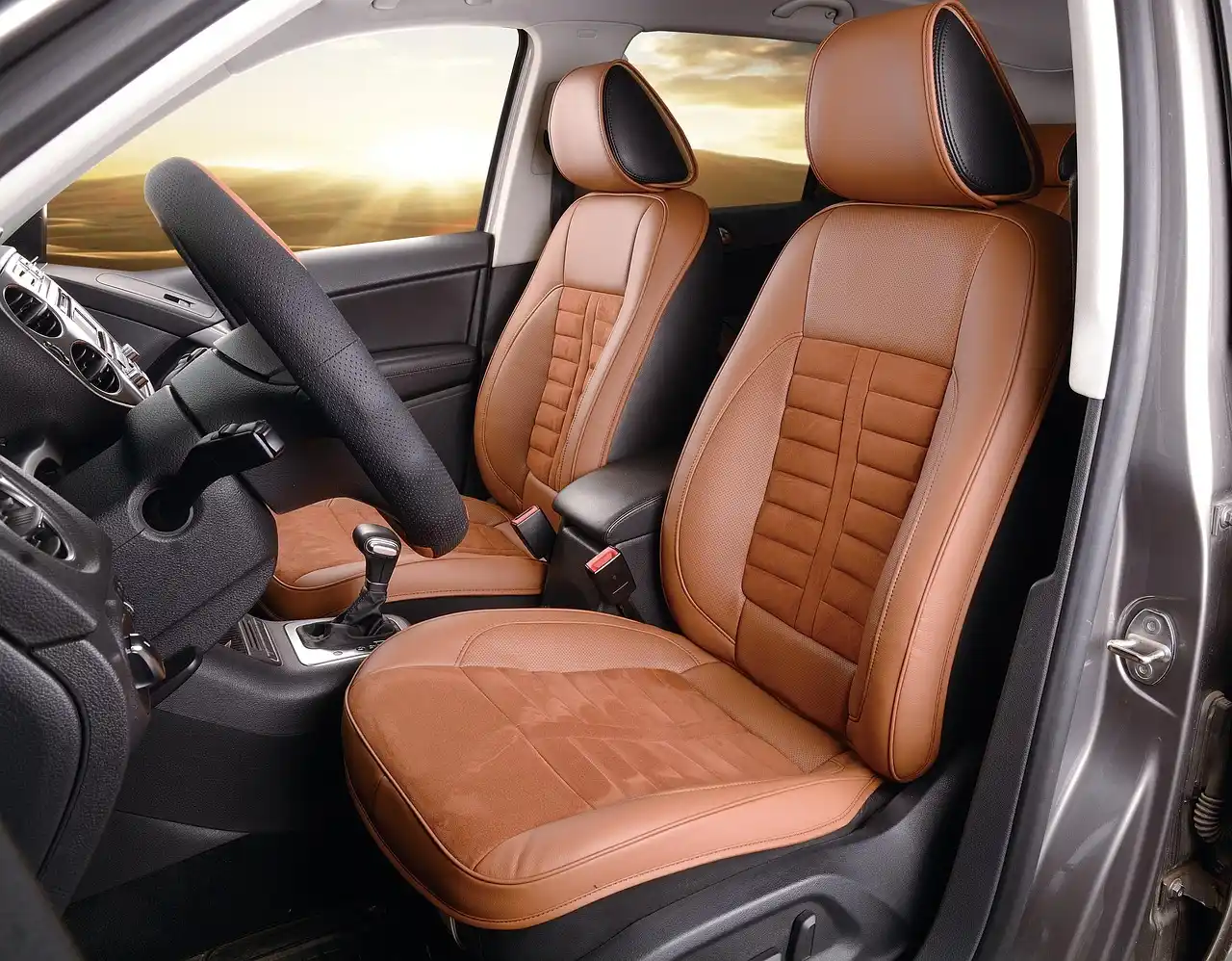
Yes, they can. That risk depends on design and fit, not only on the material. Airbag-compatible design matters because the cover must leave the deployment path clear. Built-in sensors also need a thin, stable cover that does not distort occupancy readings or block control areas.
Airbag-compatible design
If a seat has a side airbag, the cover must be built for that seat’s seam or cutout location. A generic cover can look close enough and still be wrong. If the seam is not where the airbag opens, the cover may interfere with deployment instead of yielding cleanly.
Built-in sensors and occupancy mats
Bulky covers can confuse sensors, especially in seats that monitor occupancy or belt use. A loose or heavily padded cover may press on the mat, shift the reading, or make the seat controls harder to access. Thin fit is safer than oversized bulk.
Non-slip backing and secure fit
Many covers use a non-slip backing to stay in place, often with straps or inserts. That helps with both safety and performance. If the cover slides, it can cover vent holes, change heater output, or leave a sensor area partly covered.
Suppose a sedan seat has a side airbag seam near the outer bolster and a passenger sensor under the cushion. A loose universal cover that bunches at the edge may seem fine for a day, then start shifting every time the seat is entered. That movement is enough to create a fit problem.
Should you choose a powered cushion or a passive cover?
A powered cushion makes sense when the seat has no built-in heating or cooling and the vehicle has a usable 12V outlet. A passive thin cover is the better choice when you want protection without changing the seat’s built-in function. If the vehicle already has ventilation, the safest move is usually a thin breathable cover, not extra padding.
12V power connection requirements
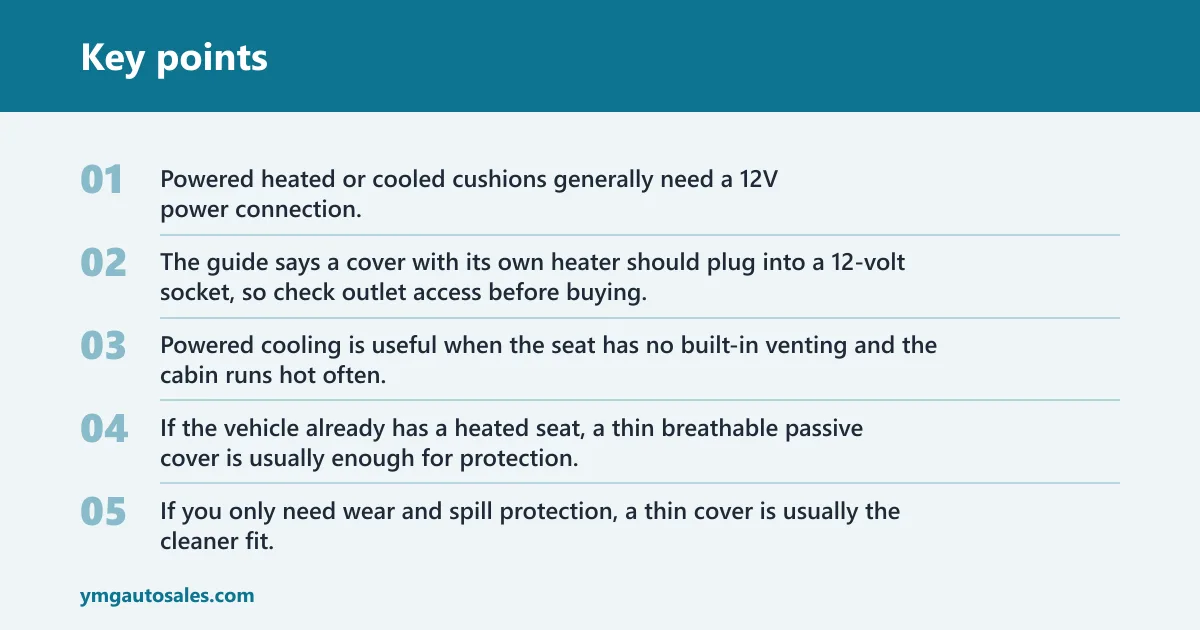
Powered heated or cooled cushions generally need a 12V power connection. That limits use in some vehicles and layouts, especially when the outlet is awkwardly placed or already needed for another device. The guide says a cover with its own heater should plug into a 12-volt socket, so check outlet access before buying.
When powered cooling is worth it
Powered cooling is useful when the seat has no built-in venting and the cabin runs hot often. That kind of setup can add comfort, but only if the power path and seat shape fit the vehicle.
When a passive thin cover is enough
If the vehicle already has a heated seat, a thin breathable passive cover is usually enough for protection. This is another category entirely: powered cushioning rather than a simple protective shell. If you only need wear and spill protection, a thin cover is usually the cleaner fit.
Frequently asked questions
Can you use seat covers on heated and cooled seats?
Yes, but only if the cover matches the seat type. Heated seats need a thin layer that lets heat pass through, while cooled or ventilated seats need airflow paths. Thick, sealed, or padded covers can weaken both functions, so the right material and fit matter more than the label on the package.
Do seat covers block heated seats from warming up?
They can. A thin breathable cover usually still lets heat move through, but thick or insulating material slows warm-up and can make the heater feel weaker. The goal is to keep the cover light enough that it does not trap the heat before it reaches the sitter.
Do seat covers block ventilated or cooled seats?
Yes, if they are dense, padded, or sealed. Ventilated seats depend on airflow through holes or channels, and a cover that closes those paths reduces cooling fast. Breathable mesh fabric or a perforated design is the safer choice when you want the vent function to keep working.
Are universal seat covers okay for heated seats?
Sometimes. GiTenvy is described as a universal seat cover compatible with most vehicle seats, but universal fit does not guarantee proper airflow or sensor clearance. A universal cover can often work on a heated seat if it is thin, breathable, and shaped well enough to stay flat without bunching.