Are Steering Wheel Covers Universal or Size-Specific?

“Universal” steering wheel covers still depend on size, and the wheel’s outside diameter plus grip thickness matter; many passenger-car covers are commonly listed for about a 14.5- to 15.5-inch diameter range. A cover that is too loose can slip, twist, or block button access, while one that is too tight can crack or make steering feel awkward. This covers the measurements, wheel shapes, and product labels that actually determine fit.
What universal fit really means
“Universal” is a marketing label, not a guarantee. In practice, it usually means the cover fits a range of common wheel diameters, often around 14.5 to 15 inches, or sometimes 14.5 to 16 inches depending on the model. The right fit still depends on the wheel’s diameter, grip thickness, and whether the wheel has thick spokes or built-in controls.
What “universal” usually means on a product label
Many universal-fit covers are built for standard passenger cars, where wheel sizes cluster around the 14 to 15 inch range. Road & Track says standard-size heated covers fit wheels up to 15 inches in diameter, and MotorTrend lists fit ranges such as 14.5 to 15 inches. Those numbers are ranges, not promises for every wheel shape.
Wheelskins says it offers “a size to fit every vehicle,” and it sells genuine leather covers in three styles. That wording still leaves the buyer responsible for matching the right size to the wheel, because a cover that works on one 15-inch wheel may not work well on another with thick factory padding or a bulky rim.
Where size limits still apply
Universal-fit covers can fail when the wheel is thick, the spokes are wide, or the wheel controls sit close to the rim. A cover may match the diameter but still feel tight over a thick OEM grip. It may also be loose on a slim wheel, which can let the cover rotate under your hands.
Say your wheel measures 15 inches across, but the rim feels thick and padded. A cover labeled for 15-inch wheels may still be a poor choice if the inner opening is designed for a slimmer rim. The fit problem is not the diameter alone; the grip profile changes the final result.
📊 MotorTrend says many steering wheel covers fit 14.5 to 15 inches side-to-side. Source: Motortrend.
How to measure steering wheel fit

Measure the wheel end-to-end across the outside diameter first, then check the grip circumference and thickness. Diameter is the main sizing number most brands print, but grip circumference determines whether the cover stretches into place without fighting the wheel. If you use centimeters, convert carefully before ordering.
Measure wheel diameter end-to-end
The diameter is the straight-line distance across the wheel from one outer edge to the opposite outer edge. On many passenger cars, that number falls around 14 to 16 inches. Measure through the center of the wheel, not around the outside edge, because a tape wrapped around the rim will give you circumference instead of diameter.
Find the widest straight line. Place the tape measure across the wheel from one outside edge to the other, passing through the center. Read the number in inches first, because most product pages list diameter that way.
Check the wheel shape. Look for flats, thick padding, or oversized spokes that interrupt a simple circle. Those features matter because a wheel with a 15-inch diameter can still fit like a larger wheel once a cover has to stretch over extra material.
Check grip circumference and thickness
Grip circumference is the distance around the wheel’s rim, while thickness is how bulky the rim feels in your hands. A wheel can match the correct diameter and still be a bad fit if the rim is thick. That is common on some trucks, SUVs, and performance wheels with substantial OEM grips.
A non-slip inner lining matters here. It helps the cover stay planted on the rim instead of rotating as you turn the wheel. That matters most when the cover is near the upper end of its size range, where a loose fit can turn into a safety issue.
Convert inches and centimeters
Many shoppers use metric measurements, so a quick conversion helps. A 15-inch wheel is about 38.1 cm. A 37 cm wheel is about 14.6 inches, which places it near the standard passenger-car range and near the lower side of many universal-fit labels.
| Wheel diameter | Approx. size band | Fit guidance | Red flag |
|---|---|---|---|
| 14.0 to 14.5 in | Small standard-car band | Look for a cover at the tighter end of the standard range. | Loose-fit risk rises if the wheel has a thick OEM grip. |
| 14.5 to 15.0 in | Common universal-fit band | Many covers are listed here, including sizes up to 15 inches. | Check spoke clearance and inner lining before buying. |
| 14.5 to 15.25 in | Extended standard band | Useful when a brand lists a slightly wider fit window. | Thick-grip wheels can still feel cramped. |
| 15.0 to 16.0 in | Large passenger or light-duty band | Look for models that explicitly mention larger sizing. | Some standard covers will not stretch enough. |
| About 22 in | Heavy-duty truck band | Typical for large truck-specific covers. | Standard car covers are too small for this size. |
Record diameter and grip size. Write down the wheel diameter, then note whether the rim feels slim, medium, or thick. If the wheel has controls built into the spokes, mention that too because some covers need extra room around those areas.
Convert the measurement. If your wheel is 37 cm, treat it as about 14.6 inches. That lands near common standard fit ranges, but you still need to check the product’s exact size band and the wheel’s thickness.
What size steering wheel cover fits your wheel?
The right size depends on where your wheel sits within the common bands. Standard passenger-car covers often fall in the 14 to 15 inch range, while some universal models are listed for 14.5 to 15 inches or 14.5 to 16 inches. A 15-inch wheel often fits those ranges, but thickness and wheel shape still matter.
Standard passenger-car wheel sizes
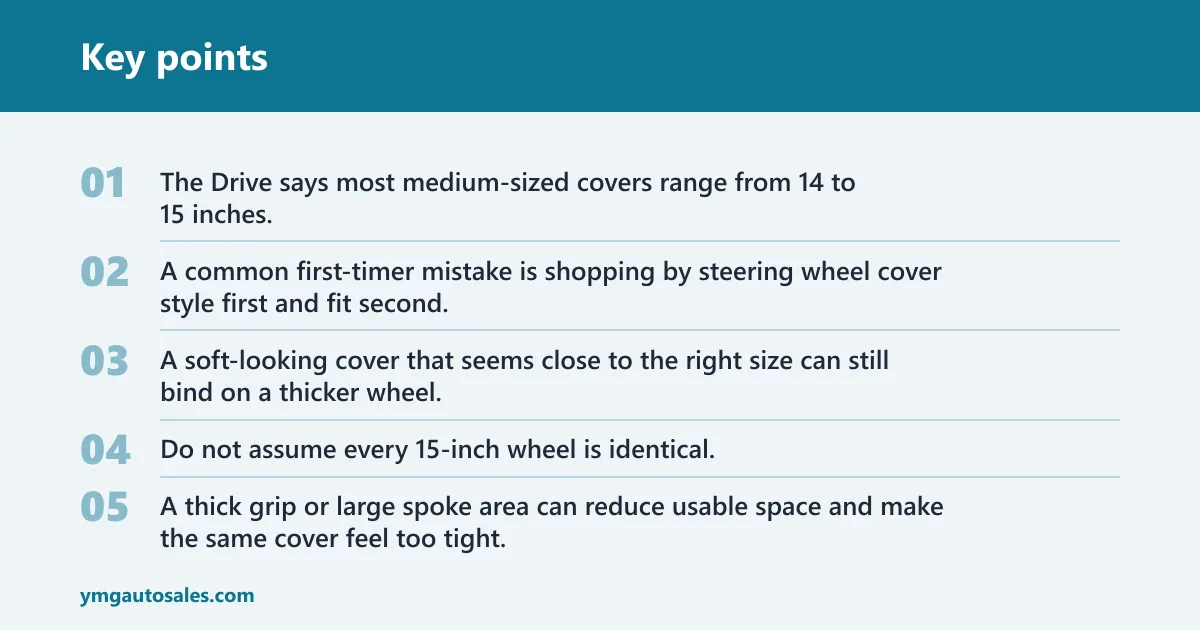
The Drive says most medium-sized covers range from 14 to 15 inches. MotorTrend lists fits such as 14.5 to 15 inches, and Road & Track says standard-size heated covers fit wheels up to 15 inches in diameter. Those figures line up with the common passenger-car market, where most buyers should start.
A common first-timer mistake is shopping by steering wheel cover style first and fit second. A soft-looking cover that seems close to the right size can still bind on a thicker wheel. That is especially true if the wheel has a thicker OEM grip than the average sedan wheel.
What size fits a 15-inch wheel?
A 15-inch wheel usually fits covers listed for about 15 inches, often in the 14.5 to 15-inch or 14.5 to 15.25-inch range, depending on the brand and rim thickness. Do not assume every 15-inch wheel is identical. A thick grip or large spoke area can reduce usable space and make the same cover feel too tight.
What size fits a 37 cm wheel?
A 37 cm wheel is about 14.6 inches. That usually puts it inside the standard passenger-car range and near many universal-fit labels. If the wheel is slim, a 14.5 to 15 inch cover may work. If the rim is thick, choose the larger end of the stated range only if the product specifically allows it.
Oversized wheels and thick grips
Oversized wheels need more caution because the cover must stretch farther without moving around. Trucks, SUVs, and some performance wheels often have thicker grips or larger diameters that push them outside the common passenger-car range. In those cases, the fit label on the package matters more than the word “universal.”
Suppose a truck wheel measures 16 inches across and has a thick rim. A cover designed for 14.5 to 15 inches may never sit fully flush, and it may twist when you turn. That is a fit failure, not a minor cosmetic issue.
Steering wheel cover fit calculator
This quick decision path helps separate standard wheels from oversized ones. Use diameter first, then check grip thickness and vehicle type. If the wheel is near the edge of a size band, choose the brand’s stated range, not the marketing word on the box.
Measure the outside diameter. If your wheel is between 14 and 15 inches, start with standard passenger-car covers. If it is 15 inches or larger, inspect the product’s exact upper limit before buying.
Check grip thickness. If the rim feels thick, choose a cover that explicitly allows a larger or more forgiving fit. A cover that matches diameter but cannot wrap the rim cleanly will feel too tight.
Match the vehicle type. For a standard car, a common universal fit may be enough. For trucks or SUVs, look for larger sizing or a truck-specific product line, because many standard covers stop at 15 inches.
| Input | Decision | Recommended path | Red flag |
|---|---|---|---|
| 14.0 to 14.9 in | Standard car | Choose a cover in the lower-to-mid standard band. | Loose fit if the wheel is very slim. |
| 15.0 in | Standard car | Choose a cover listed up to 15 inches or 14.5 to 15 inches. | Thick grip may make the same size feel tight. |
| 15.0 in | Truck or SUV | Check for larger sizing or a vehicle-specific option. | Standard universal covers may stop short. |
| 15.5 in or larger | Oversized wheel | Look for larger or heavy-duty sizing before ordering. | Loose or partial fit is a real safety risk. |
| About 37 cm | Metric shopper | Use the 14.5 to 15 inch band as a starting point. | Do not ignore thickness or spoke clearance. |
Do trucks and SUVs need different sizing?
Often, yes. Trucks and SUVs commonly use larger wheels or thicker grips than standard passenger cars, so a cover that fits a sedan may not seat properly. Some brands offer larger options for trucks, and heavy-duty covers can be much larger. The Drive notes heavy-duty truck covers can be about 22 inches, which is far beyond standard car sizing. (Thedrive)
Larger wheel diameters
Truck and SUV wheels can sit outside the common 14 to 15 inch passenger-car range. That means the buyer should not assume a universal cover will stretch far enough. Road & Track and MotorTrend both point to common standard-size limits, which helps show why bigger vehicles often need a different product line.
Heavy-duty cover size bands
Heavy-duty truck covers may be sized for much larger steering wheels and may use tougher materials or a different fastening style. The point is not only reach but stability. If a large cover cannot anchor firmly, it can shift during turns and create a slipping hazard.
When a standard cover will not work
A standard cover will not work well if it leaves gaps, rides up on the rim, or rotates when you turn the wheel. A too-big cover can be dangerous, and The Drive warns about that directly. If the cover moves after installation, it is the wrong size, even if the package claimed universal fit.
What materials fit and feel best?
Material affects fit feel, grip, temperature comfort, and durability. Microfiber leather and genuine leather usually feel firmer and more finished, while fabric or mesh can feel lighter and less warm in hot weather. Rubber or a non-slip lining helps hold the cover in place, which matters if the size is near the upper end of the fit range.
Microfiber leather and genuine leather
Microfiber leather often gives a softer hand feel and can be easier to grip in daily use. Genuine leather is common in premium options; Wheelskins sells genuine leather covers in three styles, with listed prices of $69.75 for its original cover, $76.05 for Euro Tone, and $81.30 for Euro Perf. Those figures show that material and construction can affect cost as well as feel.
Fabric, mesh, and rubber options
Fabric and mesh can feel cooler to the touch in warm weather and less slippery for some drivers. Rubber options and textured grips can add traction. A non-slip inner lining is still important, because grip on the outside does not help if the cover shifts underneath.
Heat resistance and cold-weather comfort
Material changes the way the wheel feels in temperature extremes. Heated or heat-resistant covers can make summer use more comfortable, and warmer materials can help in cold weather. Road & Track notes that standard-size heated covers fit wheels up to 15 inches in diameter, which shows how temperature comfort and fit are tied together in real product listings.
Non-slip inner lining matters
The inner lining should stay planted on the rim instead of sliding over it. That is the main defense against loose-fit movement. If a cover feels easy to rotate by hand after installation, it is too loose for safe use, even if it looked correct in the package.
Frequently asked questions
Are steering wheel covers universal or do I need a specific size?
You usually need a specific size range, even when the product says universal. Most covers are built around common diameters such as 14 to 15 inches, 14.5 to 15 inches, or 14.5 to 16 inches. The wheel’s thickness and shape still matter, so universal is a starting point, not a guarantee.
How do I measure my steering wheel for a cover?
Measure straight across the wheel from outside edge to outside edge to get the diameter. Then check how thick the rim feels in your hands and whether the wheel has bulky spokes or controls. Those extra details can change whether a cover fits snugly or feels cramped.
What size steering wheel cover fits a 15-inch wheel?
A 15-inch wheel often fits covers listed up to 15 inches, 14.5 to 15 inches, or 14.5 to 15.25 inches. That said, wheel thickness matters. A thick OEM grip can make a cover in that same size range feel too tight, so check the product’s fit notes before ordering.
What steering wheel cover fits a 37 cm wheel?
A 37 cm wheel is about 14.6 inches, so it often falls in the standard passenger-car range. Many buyers would start with a cover labeled 14.5 to 15 inches. If the wheel is thick or has large controls, choose carefully, because a small change in rim bulk can affect fit.
Are steering wheel covers dangerous if they are too loose?
Yes. A loose cover can slip, twist, or rotate during steering, which can distract the driver and reduce control feel. The Drive warns that a cover that is too big can be dangerous. If the cover moves by hand after installation, it is not the right fit.
Do steering wheel covers fit trucks and SUVs differently?
Often they do. Trucks and SUVs can use larger wheel diameters and thicker grips than standard cars, so many passenger-car covers are too small or too loose. Some brands offer larger options for trucks, and heavy-duty covers can be much larger, with some truck-specific products reaching about 22 inches.
What is the diameter of a steering wheel?
The diameter is the straight-line distance across the wheel from one outer edge to the opposite outer edge. It is the main size number used for cover shopping. On many passenger cars, it commonly falls around 14 to 16 inches, which is why that range appears so often on product pages.
How tight should a steering wheel cover fit?
It should fit snugly enough that it does not rotate, slide, or bunch up, but not so tightly that it stresses the material or distorts the rim. A good fit stays centered and stable while still allowing normal steering. If you can turn the cover independently of the wheel, it is too loose.