How to Read a Wheel Size Chart Without Getting Confused
Read a wheel size chart by matching the three fit-critical numbers first: diameter, width, and bolt pattern. If any one of those does not match your vehicle, the wheel will not fit. A bad read can waste money on parts that rub, bolt up badly, or cannot mount at all. This guide shows how to decode each chart entry and spot the measurements a chart cannot confirm, like offset, hub bore, and brake clearance.
What a wheel size chart can tell you
A wheel size chart can show the wheel’s listed dimensions, such as rim diameter, rim width, offset, bolt pattern, and center bore. It can also show the wheel’s mounting style and, on some listings, its load rating. What it cannot confirm is vehicle-specific fit, brake clearance, or whether a tire size will work with the suspension and body space.
The specs the chart can confirm
The chart is strongest when it lists the wheel itself, not the vehicle. Look for diameter in inches, width in inches or J-format, offset in millimeters, bolt pattern such as 5×114.3 or 5×112, and center bore in millimeters. Those numbers tell you what the wheel is, but not whether every part of your car can accept it.
The fitment checks it cannot confirm
A chart cannot see your brake caliper shape, hub lip height, suspension travel, fender room, or whether a tire sidewall will clear under steering lock. It also cannot prove that a wheel’s load rating meets your vehicle’s needs. To verify those points, use the door placard, the owner’s manual, the wheel or vehicle maker’s listing for your exact model, and a fitment calculator or vehicle-specific database.
Decode a wheel size label
Most labels read from left to right, and each part carries a different fitment clue. A marking like 17×7.5J ET35 5×114.3 66.1 indicates the wheel diameter, width, bead profile, offset, bolt pattern, and center bore. Read every piece separately so you do not mix up wheel size with tire size or assume the chart says more than it does.
Diameter and width
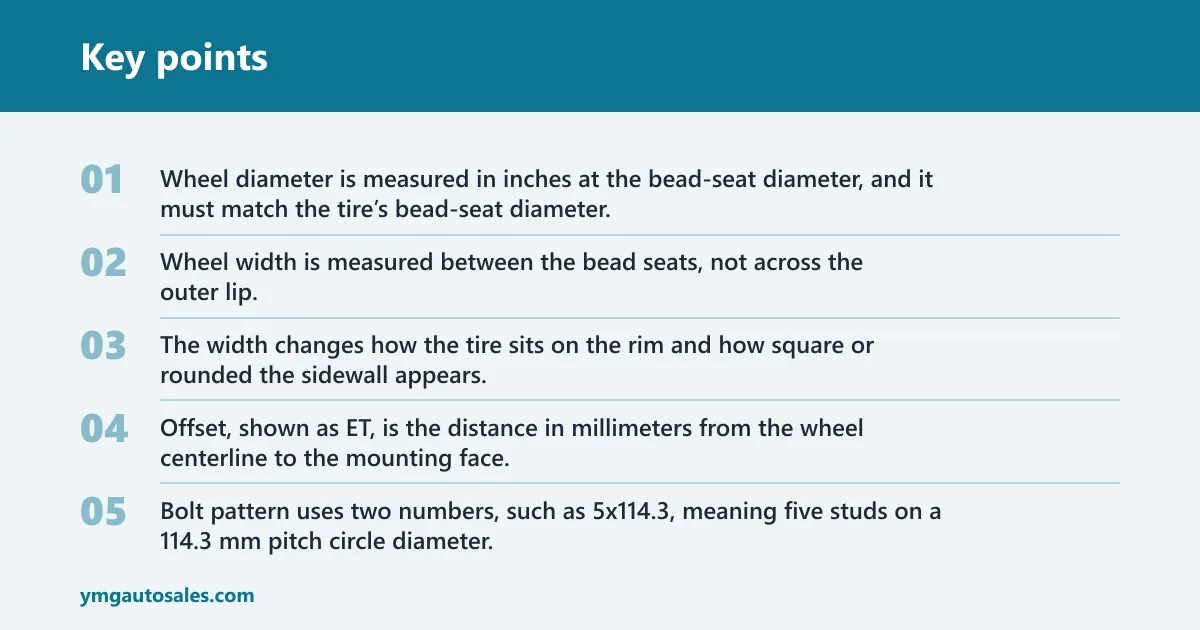
Wheel diameter is measured in inches at the bead-seat diameter, and it must match the tire’s bead-seat diameter. Wheel width is measured between the bead seats, not across the outer lip. Labels like 6.5J, 7J, and 8.5J include the width number, and the J identifies the bead-seat contour and mounting profile. The width changes how the tire sits on the rim and how square or rounded the sidewall appears.
Offset, bolt pattern, and center bore
Offset, shown as ET, is the distance in millimeters from the wheel centerline to the mounting face. Positive offset pulls the wheel inward; zero offset places the mounting face near the centerline; negative offset pushes the wheel outward. Bolt pattern uses two numbers, such as 5×114.3, meaning five studs on a 114.3 mm pitch circle diameter. Center bore is the hub opening in millimeters and may need hub rings if the wheel bore is larger than the hub.
J-bead and mounting style
The J in 7.5J points to the bead-seat contour and mounting profile, which matters for tire bead seating and tire compatibility. Most passenger car wheels are single-piece wheels with a standard lug-seat mounting style, but the chart may not spell that out clearly. If a listing uses unusual mounting hardware or a nonstandard seat type, check the manufacturer’s spec sheet before ordering.
Wheel size worksheet
Use this worksheet to decode a label line by line and separate what it proves from what it cannot prove. The examples below are automotive wheel labels, not tire labels. The tire compatibility note shows the tire-side check you still need to make after reading the wheel chart.
| Example label | Diameter | Width | Offset | Bolt pattern | Center bore | Tire compatibility note | Fitment risk |
|---|---|---|---|---|---|---|---|
| 17x7J ET45 5×114.3 67.1 | 17 in | 7J | ET45 | 5×114.3 | 67.1 mm | Needs a tire that fits a 17-inch rim, such as 225/45R17 or another approved size for that width | Chart cannot confirm brake clearance or whether the 67.1 mm bore matches the hub without rings |
| 18×8.5J ET35 5×112 66.6 | 18 in | 8.5J | ET35 | 5×112 | 66.6 mm | Requires an 18-inch tire fitment, such as 245/40R18 if the vehicle allows that width | Wide wheel may clear the tire but still hit a caliper or fender; chart cannot verify space |
| 16×6.5J ET40 4×100 54.1 | 16 in | 6.5J | ET40 | 4×100 | 54.1 mm | Fits only tires built for 16-inch rims, such as 205/55R16 when approved for the vehicle | 4×100 must match the hub pattern exactly; chart cannot confirm stud length or lug-seat match |
| 19x8J ET50 5×120 72.6 | 19 in | 8J | ET50 | 5×120 | 72.6 mm | Must pair with a 19-inch tire size, such as 235/45R19 if approved by the vehicle maker | Chart cannot tell whether the wheel clears oversized brakes or whether load rating suits an EV or SUV |
| 20x9J ET25 6×139.7 106.1 | 20 in | 9J | ET25 | 6×139.7 | 106.1 mm | Requires a 20-inch tire size, and the width may demand a specific section width range | Chart cannot verify truck brake clearance, wheel well room, or whether hub rings are needed |
How do wheel and tire sizes work together?
Wheel and tire sizes must match at the bead-seat diameter first, or the tire will not mount. After that, wheel width changes how the tire profile sits on the rim, which affects sidewall shape and steering feel. A chart can show the wheel side of the pairing, but the tire side still has to be matched to the vehicle and the wheel width.
Matching rim diameter to tire size
Tire sizes like 225/45R17 include three key pieces: section width, aspect ratio, and rim diameter. The last number, 17, must match the wheel diameter. A 225/45R17 tire is meant for a 17-inch wheel, while a 225/45R18 tire is for an 18-inch wheel, even if the width and aspect ratio look similar.
Why width changes tire shape
A wider wheel pulls the tire shoulders outward and makes the sidewall stand straighter. A narrower wheel leaves more sidewall bulge. That change affects appearance and handling, and it can move the tire closer to fender or suspension parts. The chart can show the wheel width, but it cannot tell you the approved tire-width range for every model.
Common misreads to avoid
A common first-timer mistake is confusing wheel diameter with tire sidewall height. The 17 in 225/45R17 is the rim diameter, not the tire’s height. Another mistake is reading ET35 as a tire spec or assuming a wheel that fits a tire size will also clear brakes. Those are separate checks.
How do you tell whether a wheel will fit your car?
Start with the vehicle’s factory wheel information, then compare it with the wheel label. The best source order is the door placard, the owner’s manual, and the manufacturer’s listing for your exact model. After that, verify bolt pattern, center bore, diameter, width, offset, and load rating, then check brake clearance and tire fit.
- Check the factory spec. Use the door placard first, then the owner’s manual, then the vehicle or wheel manufacturer listing for your exact trim. That gives you the base wheel diameter, recommended tire size, and any load limits.
- A wrong bolt pattern will not bolt on safely.
- Compare center bore. If the wheel bore is larger than the hub, hub rings may be needed to center the wheel. If the bore is too small, the wheel will not fit over the hub lip.
- Check load rating. Find the wheel’s load rating in the manufacturer listing or stamp, then compare it with the vehicle’s needs. This matters a lot on SUVs, trucks, and EVs, where weight can be higher than on compact cars.
- Confirm brake and tire clearance. Make sure the spoke design clears the caliper and rotor, and that the tire size fits the wheel width. Follow the vehicle and wheel manufacturer manuals.
Say your door placard lists 17-inch wheels and 225/45R17 tires, but you find an 18×8.5J ET35 wheel with 5×114.3 and 66.6 mm bore. The bolt pattern might match, but the 18-inch diameter does not match the 17-inch tire size. The chart already tells you that the tire will not mount on that wheel size.
Suppose a truck wheel chart shows 20x9J ET25 6×139.7 106.1 with no load rating. That listing still leaves a key gap. The wheel may bolt on, but without the load value and brake-clearance data, fitment is incomplete and should not be treated as confirmed.
What the chart cannot verify
Even a complete wheel label stops short of final fitment. It does not tell you whether the caliper, rotor, suspension, or fender lip will clear at full steering lock or full compression. It also cannot prove that the wheel’s hub fit, lug-seat style, or load rating is correct for your vehicle.
Brake and suspension clearance
Brake clearance depends on spoke shape, barrel shape, rotor diameter, and caliper size. Two wheels with the same diameter and bolt pattern can fit very differently because of spoke design. Suspension clearance can change with offset too, since moving the wheel inward or outward changes where it passes the strut or fender.
Hub fit versus lug-centric fit
Center bore matters, but it is not the only way a wheel centers. A hub-centric wheel is guided by the hub, while some lug-centric setups center from the lug hardware and seat geometry. Do not assume a larger bore alone means failure; instead, check how the wheel is designed to center and whether the manufacturer specifies rings or other hardware.
Vehicle limits and final checks
Wheel fit is only one part of the job. Tire load index, wheel load rating, and vehicle limits all matter, especially on heavier vehicles and EVs. Before buying, verify the exact wheel listing, the tire maker’s approved rim range, and the vehicle manual’s fitment limits, then compare them line by line.
Frequently asked questions
How do I read a wheel size chart
Read the label from left to right and separate each spec. Start with diameter, then width, then offset, bolt pattern, and center bore. After that, check the tire size and load rating in the listing or manufacturer spec sheet. The chart tells you the wheel’s dimensions, but not full vehicle fit.
What do the numbers on a wheel size chart mean?
They describe the wheel’s physical dimensions and mounting pattern. For example, 17×7.5J ET35 5×114.3 66.1 means 17-inch diameter, 7.5-inch width, ET35 offset, 5×114.3 bolt pattern, and 66.1 mm center bore. The J and ET marks are part of the wheel spec, not tire sizing.
What is the difference between wheel diameter, width, and offset?
Diameter is the rim size across the bead seat and must match the tire’s rim diameter. Width is the distance between bead seats and affects how the tire sits. Offset is the mounting-face position in millimeters relative to the wheel centerline, and it changes how far the wheel sits in or out.
How do I tell if a wheel will fit my car?
Match the factory diameter, bolt pattern, and acceptable offset range first. Then confirm center bore, wheel load rating, and brake clearance. The door placard, owner’s manual, and manufacturer listing are the best sources in that order. A fitment calculator can help, but it cannot replace vehicle-specific specs.
What does 17×7.5J ET35 mean?
It means a 17-inch wheel diameter, 7.5-inch width, J-bead profile, and 35 mm positive offset. That tells you the wheel size and where the mounting face sits, but not whether it clears brakes or matches your hub. You still need bolt pattern, center bore, and load rating to confirm fit.
Can I use a different wheel width or offset?
Sometimes, but only inside the vehicle maker’s acceptable range. A small change in width or offset can alter tire shape, brake clearance, and fender space. Check the wheel and tire maker’s approved ranges and your vehicle manual before changing either number, especially on SUVs, trucks, and EVs.
What mistakes do people make when reading wheel size charts?
The most common mistakes are mixing up diameter with tire height, ignoring ET and center bore, and assuming a matching bolt pattern means full fitment. Another frequent error is skipping load rating and brake clearance. A chart is a starting point, not the final proof that a wheel will work.