Are Wheel Locks a Good Idea for a Daily Driver?

Wheel locks are a smart choice for many daily drivers if theft risk is real where you park, but they are overkill when you park in low-risk areas and want the fewest service hassles. Ignore that tradeoff and you can end up with damaged keys, slower tire work, or a stolen set of wheels. This guide gives a simple yes-or-no framework, the main tradeoffs, and the daily-use costs that matter most.
When wheel locks are worth it
For a daily driver, wheel locks make sense when wheel theft is a real concern and you can live with a little extra service hassle. They deter theft, but they do not guarantee protection. If your car lives in a low-risk garage and needs frequent tire work, standard lug nuts are often the cleaner choice.
The short answer for low-risk parking
If you park in a private garage, use a well-lit spot with low overnight exposure, and run factory wheels, wheel locks are often optional. Standard lug nuts are faster for rotations, brake jobs, and roadside tire work, and they avoid the headache of a missing or damaged key.
The short answer for higher-risk parking
If you park on the street, in open apartment lots, or in places where wheel theft is common, wheel locks make more sense. The extra step for service is easier to justify when the wheels are expensive or visible enough to draw attention.
What wheel locks do and do not do
Wheel locks typically replace one standard lug nut per wheel, though some kits include a full set of four. Each lock uses a matching key pattern that fits only that lock family. That pattern slows theft by forcing a thief to stop, identify the code, or use specialized removal tools.
How the matching key pattern works
The locking lug nut key is a socket with a specific internal pattern. It must match the installed lock to remove or install the wheel. Some owners keep the key in the vehicle toolkit or glovebox, but that only helps if the key is protected from loss and easy to find when a tire needs service.
Why they slow down wheel theft, not stop it
Wheel locks are a theft deterrent, not a guarantee. A determined thief with enough time and the right tools can still remove them, especially if the vehicle sits overnight and the wheels are valuable. Their real value is making the theft slower, louder, and less convenient than standard lug nuts.
Wheel lock decision matrix
Use this matrix to score the daily-driver tradeoff. Rate each factor from 1 to 3, then add the total. Low totals favor standard lug nuts. Higher totals favor wheel locks, especially if the vehicle has aftermarket wheels or spends nights in open parking.
| Factor | 1 point | 2 points | 3 points |
|---|---|---|---|
| Parking exposure | Private garage, screened parking, low overnight exposure | Mixed parking, some overnight street time | Open lot, street parking, frequent overnight exposure |
| Wheel value | Standard factory wheels | Mid-price replacement wheels or newer OE wheels | Aftermarket wheels, premium tires, or hard-to-replace fitment |
| Neighborhood theft risk | Low risk, little wheel theft history nearby | Moderate risk or uncertain conditions | Known wheel-theft pressure or repeated incidents nearby |
| Service frequency | Rare tire work, few rotations, little roadside exposure | Regular rotations or occasional seasonal swaps | Frequent tire service, ride work, or heavy roadside reliance |
| Tolerance for inconvenience | Low tolerance for extra steps and delays | Can handle some added service time | Comfortable keeping track of a key and extra steps |
| Risk of losing the key | Key stored in a fixed, known place | Key sometimes moved around | High chance the key gets misplaced |
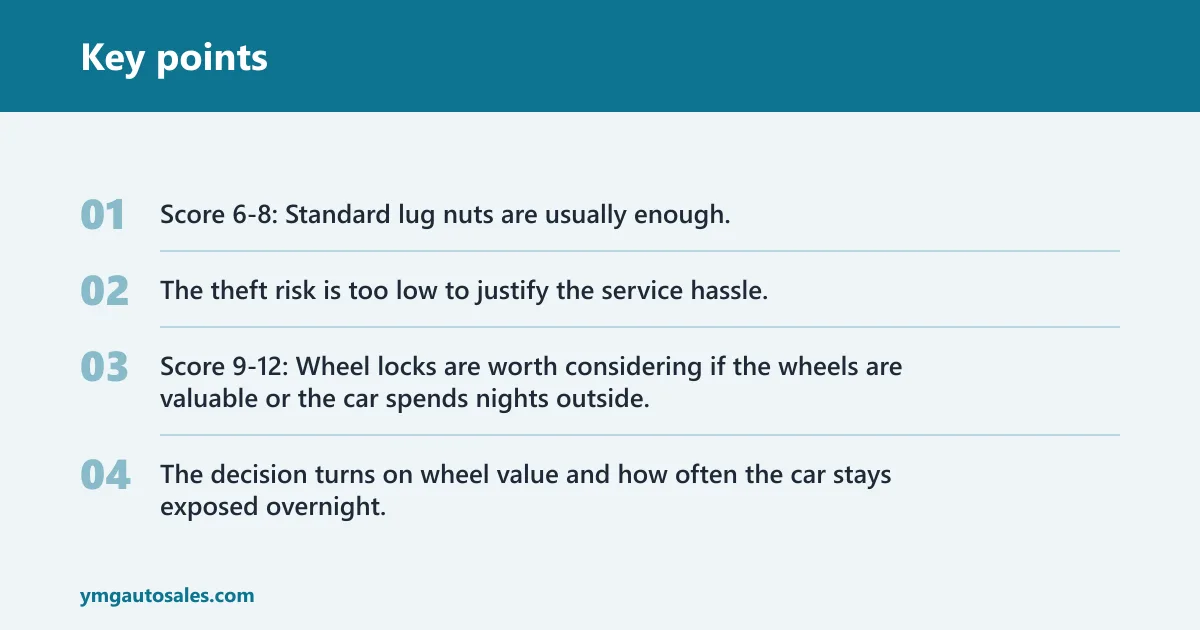
Score 6-8: Standard lug nuts are usually enough. The theft risk is too low to justify the service hassle.
Score 9-12: Wheel locks are worth considering if the wheels are valuable or the car spends nights outside.
Score 13-18: Wheel locks make sense for this daily driver, especially with aftermarket wheels or repeated overnight street parking.
Say your sedan sits in a locked garage Monday through Friday but spends weekends on the street near a busy apartment block. That mixed pattern lands in the middle band, where wheel locks can help without being mandatory. The decision turns on wheel value and how often the car stays exposed overnight.
When wheel locks make sense
Wheel locks make the most sense on daily drivers with higher-value wheels, repeat overnight exposure, or parking that is hard to control. They are also more reasonable when the owner can keep the key accessible without misplacing it. That combination gives you more theft resistance with less service pain.
Aftermarket wheels and higher-value setups
Aftermarket wheels often draw more interest than standard OEM hardware, especially if the wheels are visible and the tires are expensive. In that case, wheel locks can be a practical extra layer. They are especially sensible when the wheels cost far more than the lock kit and the vehicle stays in public parking.
Apartment lots, street parking, and mixed-risk areas
Apartment parking and street parking raise wheel theft risk because the car may sit out overnight with limited oversight. That does not make wheel locks mandatory, but it makes them easier to justify. The risk goes up again if the wheels are easy to see and the neighborhood has had theft problems.
Owners who can keep the key handy
Wheel locks work best when the key is stored in a reliable place and not buried in a moving pile of cargo. A fixed spot in the glovebox organizer or toolkit can help, as long as it stays with the vehicle and does not get loaned out or forgotten during service visits.
-
Check your parking pattern.
Count how many nights per week the car sits in open parking versus a secured garage. More overnight exposure usually pushes the decision toward wheel locks, because that is when opportunistic theft is easiest.
-
Compare wheel value.
Look at the replacement cost of the wheels and tires, not just the purchase price of the lock kit. Expensive aftermarket wheels deserve more protection than plain factory steel or basic alloy wheels.
-
Think through service access.
List how often the car needs rotations, tire repair, brake work, or seasonal swaps. If those jobs happen often, any lock pattern needs to be easy to find and in good condition.
-
Decide where the key lives.
Keep the locking lug nut key in one known place, and tell anyone who services the car where it is. A missing key can turn a simple flat repair into a delay.
When standard lug nuts are enough
Standard lug nuts are enough when the car lives in a low-risk garage, the wheels are ordinary, and fast service matters most. They are also the better choice if you hate extra steps during tire rotations or roadside repairs. Convenience matters on a daily driver.
Garage parking with low theft exposure
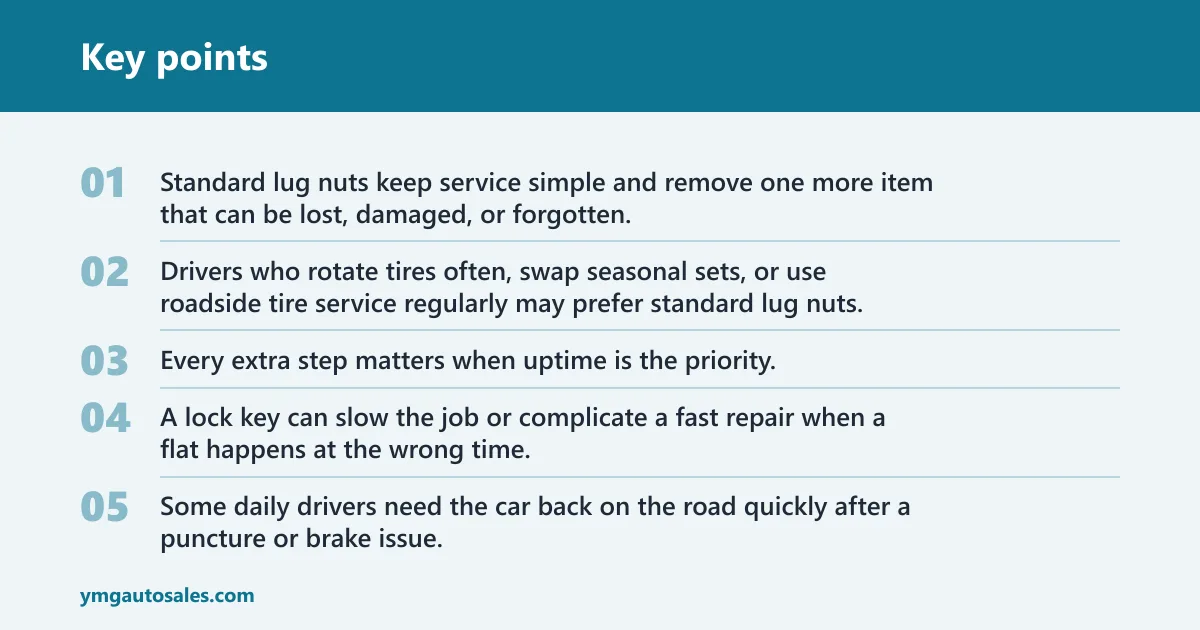
If the car sleeps in a garage and rarely sits outside overnight, the theft risk may be too low to justify locking hardware. Standard lug nuts keep service simple and remove one more item that can be lost, damaged, or forgotten.
Frequent tire service or seasonal swaps
Drivers who rotate tires often, swap seasonal sets, or use roadside tire service regularly may prefer standard lug nuts. Every extra step matters when uptime is the priority. A lock key can slow the job or complicate a fast repair when a flat happens at the wrong time.
Drivers who prioritize quick roadside service
Some daily drivers need the car back on the road quickly after a puncture or brake issue. Standard lug nuts are faster for those cases because there is no special socket to find. That is useful if the car is the main commute vehicle and downtime causes real problems.
What are the downsides?
The main downsides are service friction and failure risk. Wheel locks can complicate tire rotations, brake work, and flat repairs, especially if the key is missing or the lock is damaged. A daily driver that sees regular maintenance can spend more time parked if the hardware is not managed carefully.
Tire rotations, brake work, and flat repairs
Any time a wheel has to come off, the locking key has to be present and the lock has to fit cleanly. That affects routine rotations, brake work that needs wheel removal, and roadside tire service. If the key is not available, the simplest job can turn into a delay.
Lost keys, damaged patterns, and over-torque risk
A lost key can immobilize service until a shop or locksmith handles the lock. A rounded key or damaged lock pattern creates a similar problem. Over-torque during installation can also make removal harder than it should be, which is one reason proper fit and torque matter more than brand hype.
Picture a compact crossover with wheel locks on all four corners and a front brake job due the next morning. If the key is missing and the locks were installed too tightly, the car may need extra time at a shop before the brake work even starts. That delay is the real ownership cost.
-
Verify the key pattern.
Match the locking lug nut key to the installed lock before the first roadside need or service visit. Keep it with the car records so the pattern is not guessed later.
-
Store the key safely.
Use one fixed storage spot in the vehicle toolkit, glovebox, or center organizer. The goal is quick access without letting the key disappear during a move, cleanup, or loan to someone else.
-
Use correct torque.
Install the locks to the vehicle maker’s lug nut torque spec, not by feel. Proper torque reduces the chance of a rounded pattern or stubborn removal later.
Frequently asked questions
Are wheel locks a good idea for a daily driver?
Yes, for some daily drivers. They make the most sense when the vehicle parks outside often, the wheels are valuable, and you can live with a little extra service hassle. If the car stays in a low-risk garage, standard lug nuts are often the cleaner choice.
Do wheel locks actually prevent theft?
They help slow theft, but they do not guarantee protection. A thief can still remove them with the right tools, enough time, or a damaged-removal method. Their value is deterrence, not invincibility, so they work best as one layer in a broader parking strategy.
How much do wheel locks cost?
The lock kit itself is usually inexpensive compared with replacing wheels and tires, but the purchase price is only part of the cost. The real cost includes extra service time, the chance of a lost key, and possible removal work if the lock is damaged or over-tightened.
Can wheel locks make tire changes harder?
Yes. Tire rotations, flat repairs, brake work, and seasonal swaps all become a little more complicated because the correct key must be present. If the key is misplaced or the lock is damaged, a simple tire change can turn into a longer shop visit.
Should I use wheel locks on all four wheels?
Many kits protect one lug per wheel, and some owners use a full set on all four wheels for uniform protection. That said, more locks also mean more service points and more chances to lose the key. Use the setup that matches the theft risk and your tolerance for hassle.
Are wheel locks necessary if I park in a garage?
Usually not, if the garage is secure and the wheels are ordinary. Garage parking lowers wheel theft risk enough that standard lug nuts often make more sense. If the wheels are expensive aftermarket pieces, though, wheel locks can still be reasonable extra protection.
Can a thief remove wheel locks quickly?
Sometimes, yes. A determined thief with the right tools can defeat some locks faster than a casual thief would, especially on a vehicle left outside overnight. That is why wheel locks are best treated as a delay tactic, not a promise that the wheels will stay put.